

Introduction
In financial markets, the origin of an important inflection point is not always obvious.
Sometimes you can use prior highs or lows and evaluate the 1-year, 2-year, 5-year, 10-year, etc. cycles to determine where future highs or lows may unfold. However, sometimes the start or end of a cycle may not be exactly at these calculated highs or lows but just a bit earlier or later, or at a second high or low, or just in between a double top or bottom.
In “The 80-year echo” (#326), I showed you how the legendary commodity trader George Bayer noticed a remarkable 80-year cycle in the stock market following Mercury’s position. In last week’s post “Revisiting The 80-year echo” (#329), I further explained his rule #4 and #4A trading rules, which are effectively a recurring cycle of 79 years plus the effect 1 year later.
In George Bayer’s work, he often looks at past events or certain planetary angles to determine possible inflection points for the current trading year.
A year ago, in “Echoes of the Past: Past Patterns Unfolding Future Trends” (#257; May 4, 2025), I introduced my subscribers to several trading rules he identified 85+ years ago1.
As George Bayer’s rules are based on ancient cycles, they may still hold relevance today and be worth investigating in search of possible future inflection points. In particular, when multiple cycles line up.
In this week’s post, Bayer rule #6 may point to a similar inflection point that lines up with Bayer’s rule #4 and #4A. This time it involves the cycle of Mars, and its echo a year later. This rule may unfold in the coming months in a period similar to 120 years ago.
Bayer Rule No. 6
This rule, which George Bayer identified, does not happen very often, but as he explained, this cycle starts when Mars reaches 16°35’ in geocentric longitude of a particular sign plus 330°, and one year thereafter lines up with important lows, as you can see in the DJIA chart of 1929 to 1932 below, the example he used in his book.
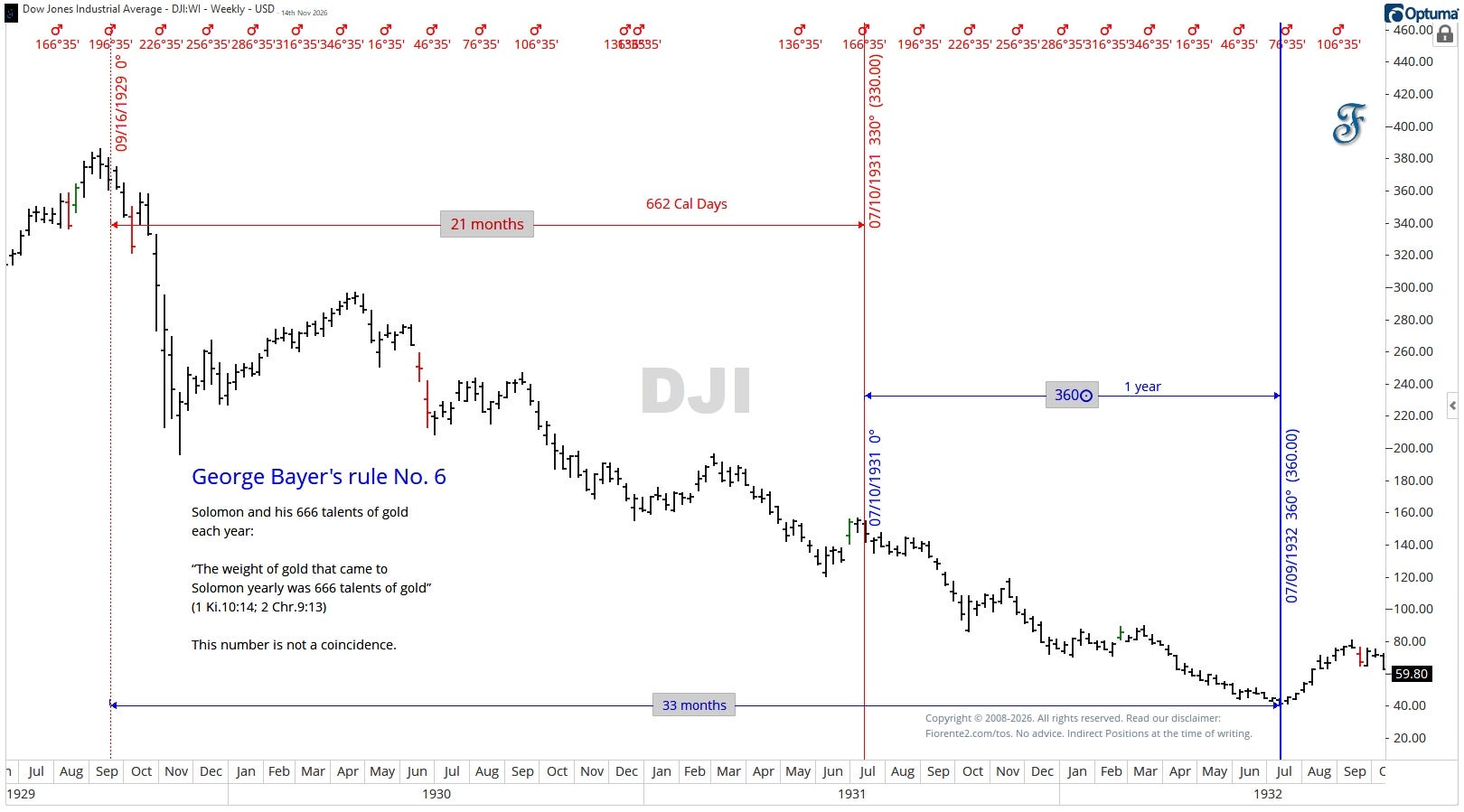
In George Bayer’s explanation of rule #6, he explains that “the year following at exactly that date we had the enormous bear market low of stocks within a day.”
Depending on Mars’s speed, 330° of Mars may line up to 666 calendar days. George Bayer may have tied this to a passage found in two parts of the Bible: “The weight of gold that came to Solomon yearly was 666 talents of gold” (1 Ki. 10:14; 2 Chr. 9:13).
Further research showed me this is a well-known 33-month cycle, equivalent to the 4th harmonic of a Sunspot cycle (11 years), approximately 1004 days, and 34 phases of the Moon. You can find this cycle in agriculture; for example, a pineapple takes exactly 33 months to grow. The stock market’s crest coincided with a relative Sunspot high, and the low point of the depression in July 1932 lined up with a Sunspot cycle low.
In today’s post, I’ll show how this rule suggests continuing to work with US indices and how it may align with the 120-year cycle. This cycle may offer clues about what could happen again in 2027.
The rest of this article is available to all free subscribers (no paywall).
© 2008–2026 Fiorente2.com. All Rights Reserved.
Disclaimer: This analysis is for informational and educational purposes only and should not be considered investment advice. Read our full disclaimer.
Disclosure: From time to time, I may hold positions in the securities mentioned.
George Bayer, Stock and Commodity Trader’s Handbook of Trend Determination, June 26, 1940. (reprint by John Ballantrae).