

Introduction
In my #321 article, “Silver futures failed to break resistance,” I envisioned a possible foldback to $90 by mid-September and noted that any low below $58 would invalidate that scenario. That was clearly a miss, as silver broke $58, fell through the 55.70 double low from June/July, and closed at $53.95 on October 23. My #321 late-December window now points the other way and silver futures are approaching cycle lows in both 6- and 18-year cycles.
You may think that, with demand for solar panels and the AI industry, silver prospects are great and that we can return to a higher high. Much depends on industrial demand. On August 13, 2026, J.P. Morgan slashed its 2026 and 2027 forecast to $63 per ounce in Q4 2026, an average of about $70 for the year, and $63 in 2027.1
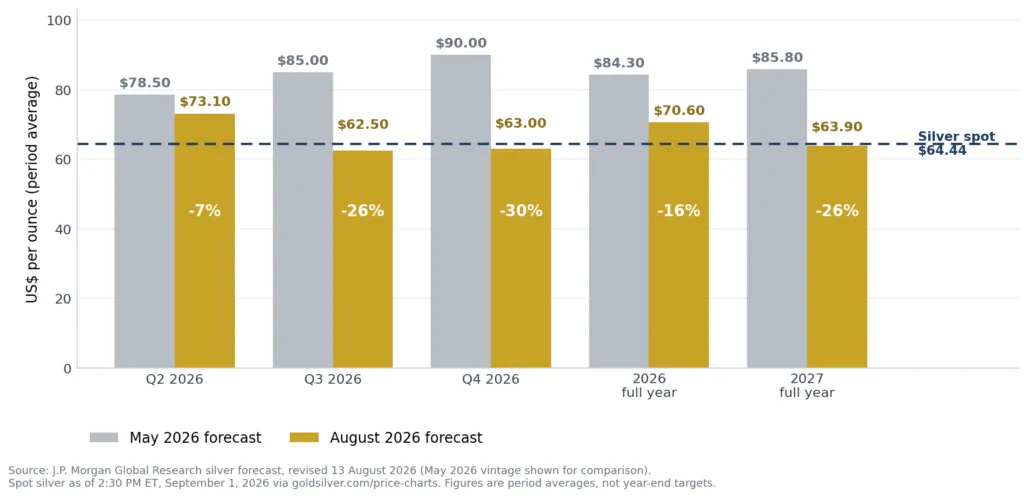
According to J.P. Morgan’s research note, the forecast cut is due to expected lower global solar demand (by approximately 30%, or ~60 million ounces year-over-year). Follow this link to J.P. Morgan’s research note.
At $53.95 per ounce on October 23, 2026, silver already trades about 14% below its $63 Q4 forecast. If the past repeats, silver could lose 72% from the upper trading band in the next few years, as it did in a similar period between 2011 and 2015. Note: I am using the same decline here, plotted from the upper trading band to a potential lower trading band, as in the 2011 to 2015 analog.
The recent drop may look like a silver lining, but I am not so sure.
Cycles repeat, and sometimes they repeat inversely, as I’ll show you below.
The remaining part of this post is available for all free subscribers (no paywall).
© 2008–2026 Fiorente2.com. All Rights Reserved.
Disclaimer: This analysis is for informational and educational purposes only and should not be considered investment advice. Read our full disclaimer.
Disclosure: From time to time, I may hold positions in the securities mentioned.
Source: J.P. Morgan Global Research: The path for silver prices in 2026 and 2027, August 13, 2026
Silver closing at $53.95 on Oct 23, roughly 14% under J.P. Morgan's $63 Q4 forecast, is a useful gap to track, especially with the forecast cut tied to about 30% lower solar demand.