

Introduction
Last week, I wrote that two scenarios were on the table. I said we’d know by the 3rd or 4th week of April which one would prevail. The market has given us an answer of sorts: a rebound into new highs. Many will take that as proof that the worst is behind us.
I’m not so sure.
In last week’s post, I also mentioned that the Mars Helio cycle carried about a 60% probability of a short-term bounce. That bounce appears to be playing out. But a bounce within a larger downtrend is still a downtrend. And when I look at the Jupiter-Saturn cycle, the 60-year pattern may still be very much intact.
Are you convinced the bull market has resumed? Or do the longer cycles tell a different story?
The 60-Year Cycle and Its Jupiter-Saturn Foundation
The nominal 60-year Gann Master Cycle isn’t arbitrary. It’s roughly 3 times the Jupiter-Saturn synodic cycle, the time it takes for Jupiter and Saturn to realign after a conjunction. Each Jupiter-Saturn cycle runs about 19.86 years, and three of those bring us to approximately 59.6 years.
The importance of the 60-year cycle is that the planets that make up the names of our weekdays, after 60 years, return to approximately the same part of the zodiac.
As I wrote earlier in a post in October 2021:
Back in 1921, Prof. Weston researched the cycles in the New York Stock Market, and he found out that the Jupiter-Saturn cycle was a very reliable cycle with an approximate cycle length of 20 years. From conjunction (0°), Jupiter-Saturn moves in about 10 years to 180°, forming the 10-year cycle, and backward again in about 10 years to conjunction, making the total move to about 20 years. The Jupiter-Saturn cycle at 3x its length (3x360=1080 degrees) is, in my opinion, the Gann Master Cycle.
As Prof Weston observed more than 100 years ago, the stock market rises in year 5 of this cycle, when Jupiter squares Saturn.
Further research has shown that the 60-year cycle appears in other aspects of our lives, including climate indices such as temperature, sea level, and oceanic oscillations. Even Jupiter’s 60-year oscillations in its orbit may affect our climate.
A 60-year cycle can be found in the calendrical systems of India and China. Even in our fashion and politics (US tariff increases in 1965/1966), we can see the effect of the 60-year cycle.
In 1966, the Democrats lost the midterm elections to the GOP, and the stock market declined sharply along with it, due to inflation fears and dissatisfaction with the Vietnam War.
If Polymarket odds are any guide, the GOP may lose the midterms this time. That could put a similar stress on the stock market as we saw in 1966. Maybe the war in Iran continues for some time to come, resonating with Vietnam. Or maybe another conflict surfaces. Time may tell.
This is why the 60-year cycle has teeth. The planetary framework underneath it keeps regenerating the same conditions, in the same sequence, decade after decade. The same resonance shows up far beyond the stock market. Themes from 60 years ago surface again in society at large.
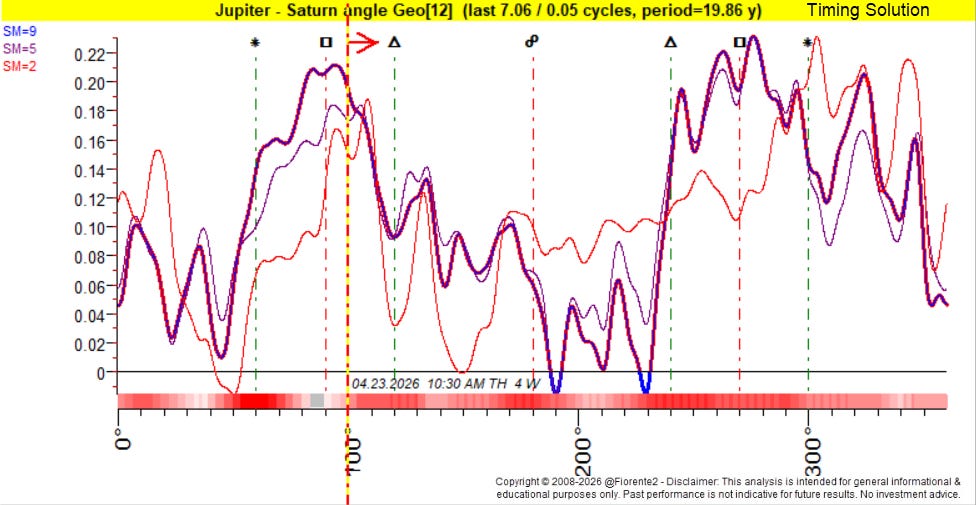
What matters right now is that the US indices may have run directly into the crest of the current Jupiter-Saturn cycle. And across the last 6 synodic cycles, roughly 120 years of data, the market has turned at this point around 80% of the time.
You can look at this path from a geocentric perspective, as shown in the chart below.
From a heliocentric perspective, the path through the zodiac looks different, as shown below.
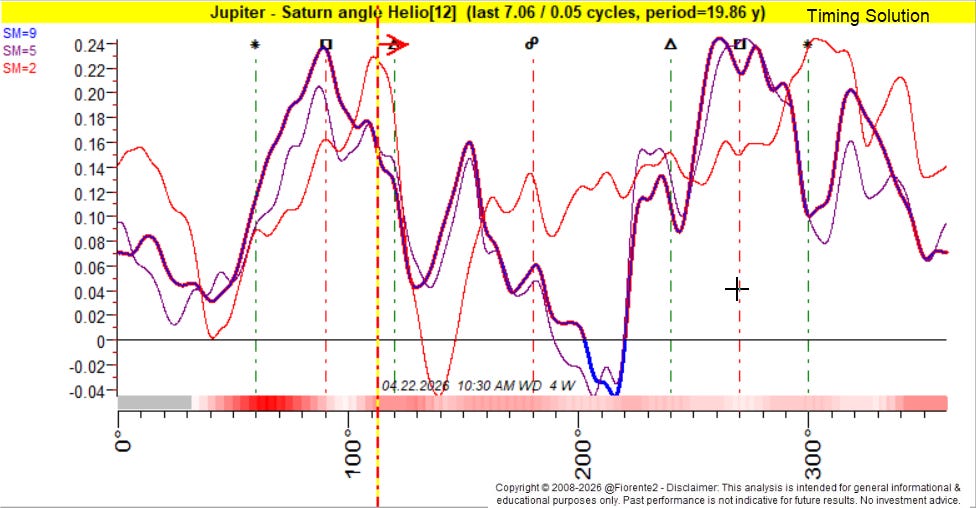
The difference between the two charts is that from time to time Jupiter and/or Saturn have retrograde periods, causing the double bottom visible on the geocentric chart between 190 and 240 degrees.
Overlaying these paths over the DJIA illustrates that the Dow is still on the Jupiter-Saturn cycle path from both perspectives.
DJIA and the Jupiter-Saturn Cycle: Geo and Helio Combined
To understand where the markets stand within the Jupiter-Saturn cycle, I’ve overlaid the DJIA with both the geocentric and heliocentric paths of the cycle in time.
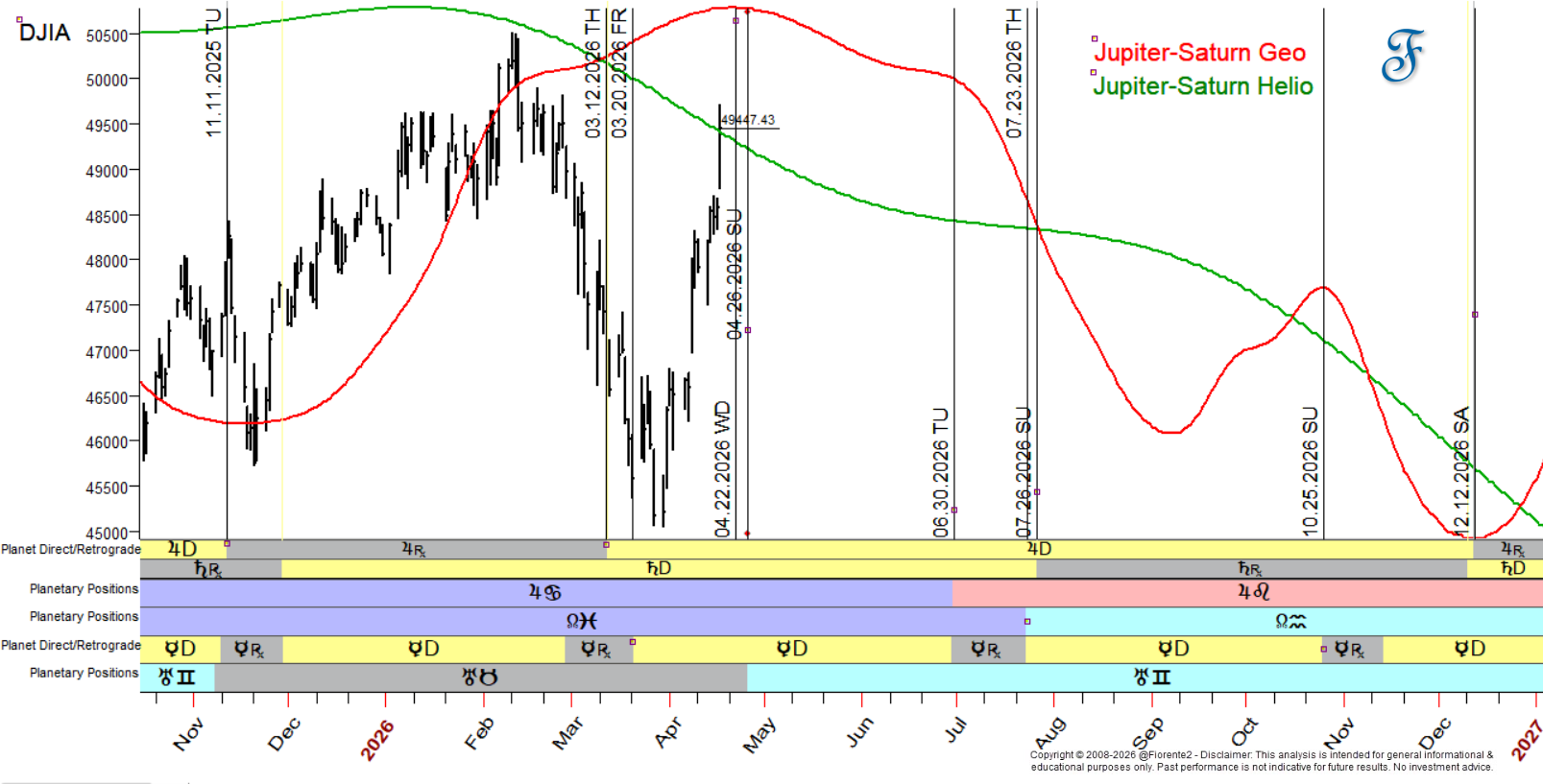
In the chart above, I have overlaid the DJIA prices with the Jupiter-Saturn geo and helio cycle paths, and displayed the retrograde periods of Jupiter, Saturn, and Mercury in the planetary positions panels, along with the ingress of the North Node into Aquarius, Uranus into Gemini, and the Jupiter Cancer–Leo ingress.
Saturn, Jupiter, and Mercury all turned direct respectively in December 2025 (Saturn) and March 2026 (Jupiter/Mercury), so those retrograde periods are behind us. The upcoming Mercury and Saturn retrograde periods and the three ingresses of Jupiter, the North Node, and Uranus are the hotspots still ahead.
A few things to note. The overlay does not forecast price. It maps the cyclical rhythm and timing onto the price chart, showing where the cycle crests, troughs, and key turning zones fall in time. Whether the market follows or inverts is always the question.
What the chart does show is that the DJIA has moved into the geo crest of the current Jupiter-Saturn cycle around April 22nd, 2026. The geocentric path is more aligned with what the actual market does, as the heliocentric path reached a crest by early February 2026. Moving forward from today, both paths appear to confirm each other.
It is always difficult to say which perspective has been the better leading indicator in previous cycles. From a geocentric view, retrograde periods may not be the same every 60 years. I always check both.
Hotspots Ahead: Retrogrades and Planetary Ingresses
At the bottom of the chart above, I’ve marked the retrograde periods of Mercury and Saturn, the North Node’s move into Aquarius, Uranus’s move into Gemini, and Jupiter’s move from Cancer into Leo in July 2026. Together, these planetary events define several hotspots to keep an eye on going forward.
For a long-term cycle like the Jupiter-Saturn cycle, it may take time before the markets turn. It’s like a ship on the ocean: it can’t immediately change direction. I’ll update the charts as we approach each of these dates.
The Probability: 80% Across 6 Synodic Cycles
The question, of course, is whether this is a coincidence or a pattern. The chart below shows the historical probability.
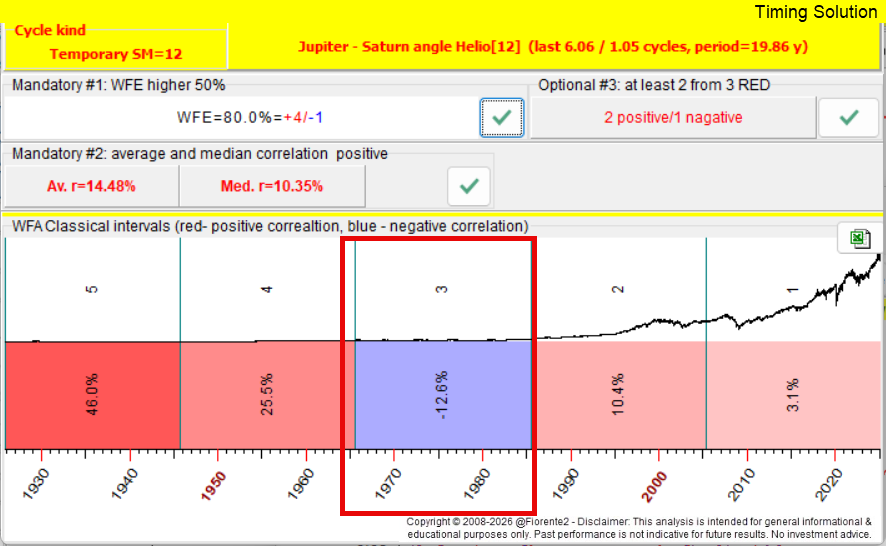
The above chart describes the probabilities of the DJIA aligning with the 6 Jupiter-Saturn cycles over the last 120 years. The only period that shows inversions is between 1966 and 1986, probably caused by retrograde periods of longer-term cycles.
Across the last 6 synodic cycles, about 120 years of data, when the markets reached this point in the Jupiter-Saturn geo cycle, the market turned approximately 80% of the time. That’s not certainty. But it’s a probability worth respecting.
What New Highs Mean Within the Cycle
The recent surge in the indices might seem to contradict the bearish case. I’d argue it doesn’t.
In last week’s post, the Mars Helio cycle pointed to a possible rebound into mid-May, with a roughly 60% probability. A short-term bounce was part of the picture, not a contradiction of it. The 60-year Gann Master Cycle from 1966 also showed a recovery phase before the larger trend resumed.
This is my bias for now. The new highs may be the “second crest” scenario I mentioned last week. Time may tell.
Conclusion
So far, the US indices appear to be following the rebound scenario I outlined last week. The Jupiter-Saturn geo cycle now adds a new layer of confirmation. The markets have run into the crest of this cycle, and historically, that has been a significant inflection point 80% of the time.
April 22nd, 2026, is the date to watch first. Beyond that, the Mercury and Saturn retrograde periods, the North Node’s move into Aquarius, Uranus’s move into Gemini, and Jupiter’s move into Leo in July 2026 mark additional hotspots through the rest of the year. I’ll continue to update these as we move closer.
I may be wrong, of course. The 20% scenario, that it may take longer than expected, exists. If the indices push convincingly past the expected time period +/- 2 weeks, I’ll update the analysis. Always watch the chart in front of you.
Remember, cycles can contract, extend, and invert. Anomalies can occur, fundamentals can shift, so be cautious. The financial markets remain highly volatile, and capital preservation is still my priority.
In case you haven’t noticed, I post various charts in the Substack notes every week. You can find them all here. (click on the link)
P.S.: Occasionally, I share new analyses exclusively for free subscribers. Subscribing gives you email updates on these posts, plus extra insights and deeper research from the time you join onward; past analyses are not included.
If you liked this post from @Fiorente2’s Blog, why not restack and share it?
© 2008–2026 Fiorente2.com. All Rights Reserved.
Disclaimer: This analysis is for informational and educational purposes only and should not be considered investment advice. Read our full disclaimer.
Disclosure: From time to time, I may hold positions in the securities mentioned.