

Introduction
I have updated last week’s post on US indices, Top-20 stocks, and Crude oil. The US Indices may be approaching an important inflection point based on the 60-year cycle and measured from the April 2025 low. Crude Oil has hit new highs, and may be folding back into a potential high by Easter, when Jupiter-Saturn synodic cycle will be close to 180 degrees from the highs in June 2014. Almost all of the Top-20 stocks remain in overbought territory from a fundamental or technical perspective.
Crude Oil
As tankers in the Strait of Hormuz remain unable to leave this area, this might cause crude oil prices to rise further to $100 per barrel or higher, reaching new highs in the coming weeks.
Based on OPIS (Oil Price Information Service) and EIA data1 as of early 2026, the Strait of Hormuz is the world’s most critical oil transit chokepoint, with roughly 20–30% of global seaborne oil trade passing through it. (Source: Strait of Hormuz Factsheet)

The blockage of cargo ships or intense fighting has disrupted the supply chain, leading ships to take longer routes to the area and preventing oil-producing countries in the region from exporting their products.
What do the cycles reveal? I have been watching the crude oil chart for several years, and it seems likely that crude oil will spike back to the levels seen in 2014, when it was around $100 to $110 a barrel.
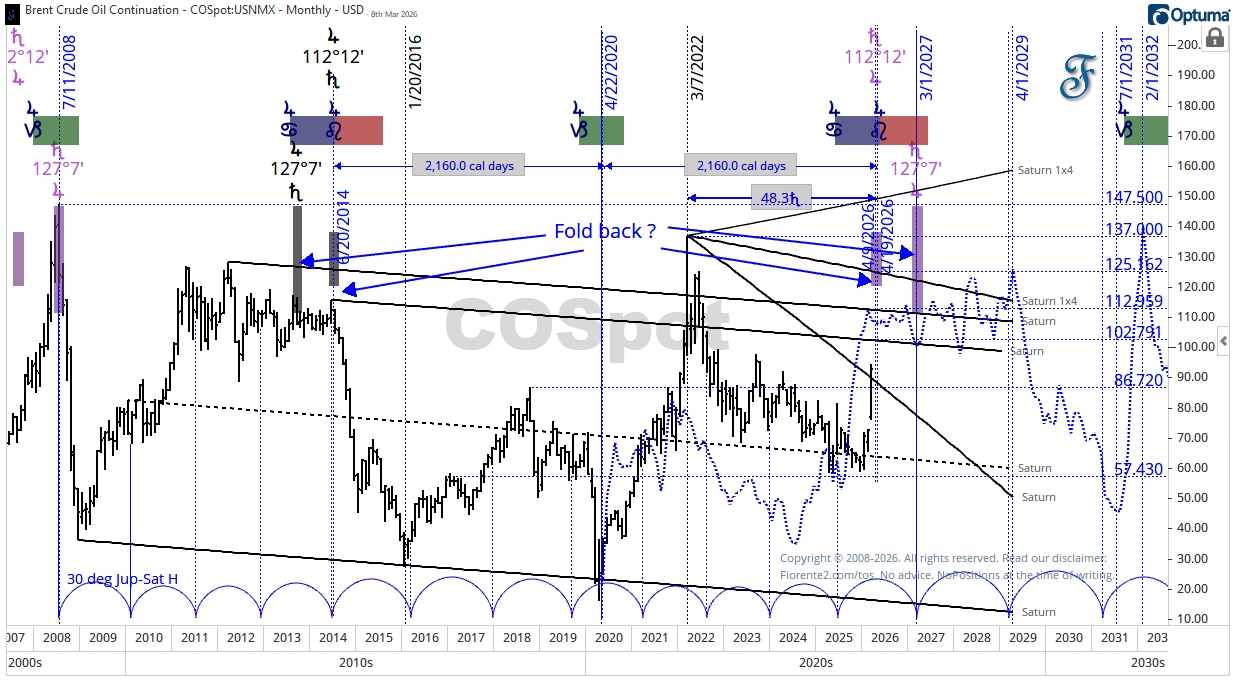
The Jupiter-Saturn cycle from a heliocentric view peaked about 12 years ago and is expected to return to the same point between February and May 2026, on an inversion of this cycle, as shown in the chart below. I expect Crude Oil to return at least to higher highs between now and May 2026. Considering the foldback, high prices may remain until early next year.
The Mars-Saturn conjunction on April 19, 2026, may be a moment when we see a change in trend again.
Measured with Saturn timing lines from past highs or lows, there is resistance at $102-$112-$125, so if this conflict continues and disrupts the energy markets, I can see these price levels reached in the next few weeks and months. This will certainly affect the price of gasoline at the pump we pay for as well.
US Indices
Crude oil and natural gas drive the global economy. These commodities are vital for major airlines and shipping companies like Maersk and Frontline (FRO), and to energy stocks already soaring toward a 12-year high. Maersk already stopped shipping to/from the Strait of Hormuz last week.
With US indices continuing to decline from all-time highs, a continuation and intensification of the conflict with Iran could further increase the risk that the stock market may decline more than anticipated based on past cycles. So, always seek confirmation if a cycle might have turned.
So, let’s examine the main US indices and some relevant cycles that might be active, starting with the New York Stock Exchange Composite Index (NYA).
NYSE Composite (NYA)
The NYSE Composite reached a similar high exactly 60 years ago but has not yet followed this cycle with a decline. It seems more likely that the stock market will follow the 22-year cycle in a more phased decline until mid-August this year, or earlier, by the end of June, 15 degrees of Saturn Helio from the April 7th, 2025, low.
An end-of-June-early July 2026 low may align with 3 Venus-Uranus 180-degree Helio moves from the April 2025 low. The next inflection point on this cycle is March 13th, 2026. We may see a rebound here correlating with the 60-year cycle.
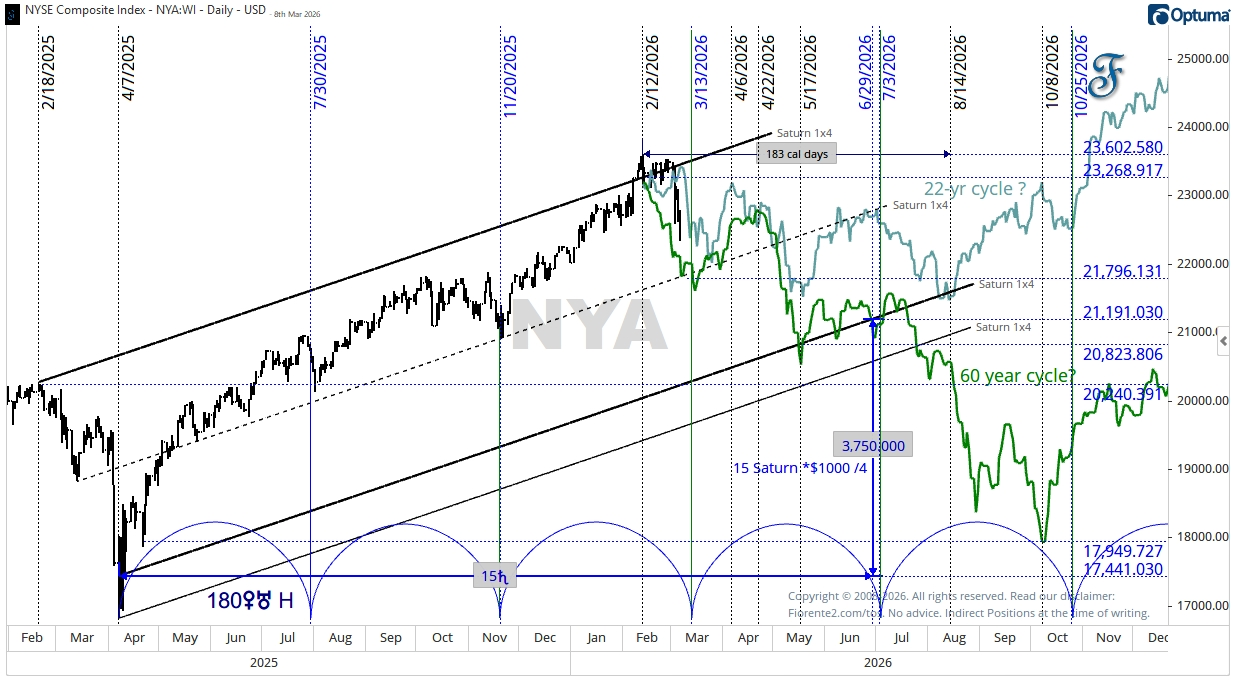
Note: the 22-year cycle is interesting as the USA was active in a conflict with Iraq, which is in the same region. This is why I have been following this cycle, earlier identified by George Lindsay in his ‘Aid To Timing’-thesis.
DJIA
A similar story can be mentioned for the DJIA. Note how the DJIA squared out on the high of early February already on a Saturn 1x2 timing line, on the same date as 60-years ago, and how the synodic cycle of Venus-Uranus Helio has unfolded so far (give or take a few days).
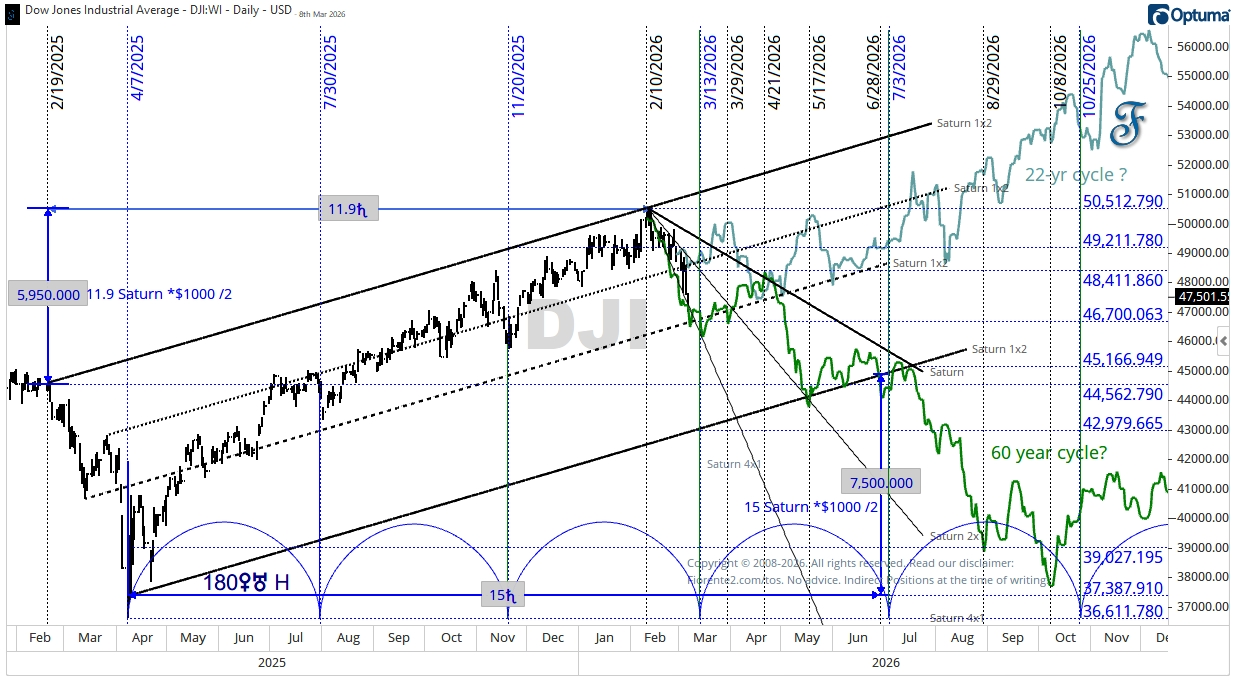
As mentioned last week, “I honestly don’t know if the DJIA will continue to follow the 60-year cycle or the 22-year cycle shown on the chart. I have no crystal ball. The themes of the past (such as tariffs, the Vietnam War 60 years ago, and the Iraq War 22 years ago) still apply, but the current situation may differ slightly. We’ll have to see how the current conflict develops.”
S&P 500
I prepared a similar chart for the S&P 500 using the Saturn timing lines from past highs and lows and added the Venus-Uranus synodic cycle. The S&P 500 seems to be declining into a low by mid-March 2026 on a first leg downwards, perhaps following the 60- or 22-year cycle. Roughly, they follow a similar direction for some time.
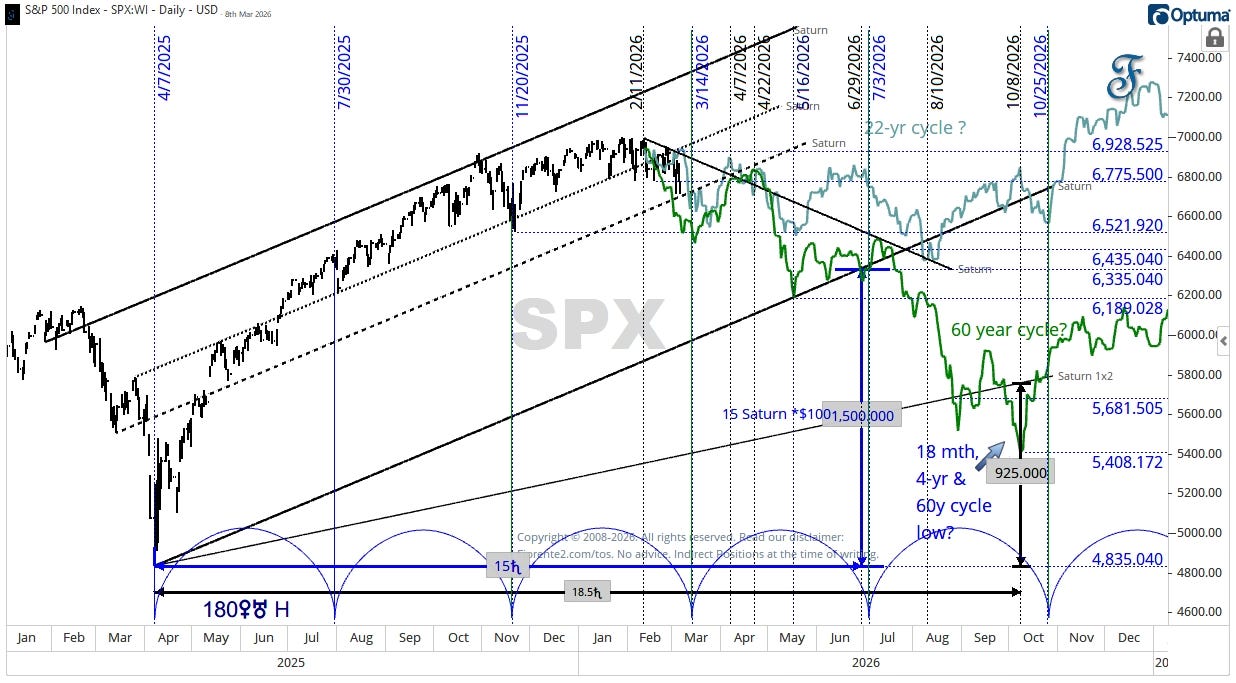
My bias for this year is the repeat of the 22-year cycle, but a 60-year cycle is a larger cycle and may become more dominant. The economy is resilient, and if the current actions in Iran end as favorably as 22 years ago, we may see the S&P 500 (and the other US Indices) bounce off the lower Saturn timing lines. Price levels may vary by index.
Nasdaq 100
The Nasdaq was not around 60-years ago, so I plotted only the 22-year cycle on the chart below. I have added a Saturn-Planetary Fan from the recent high in January that might give an idea of where the index may be heading if the downtrend continues.
Certainly, the same 60-year cycle will apply, but we do not know how this cycle might have behaved 60-years ago.
I have added the synodic cycle of Venus-Uranus Helio to the chart, projected from the April 2025 low, and it is showing nice inflection points within a few days.
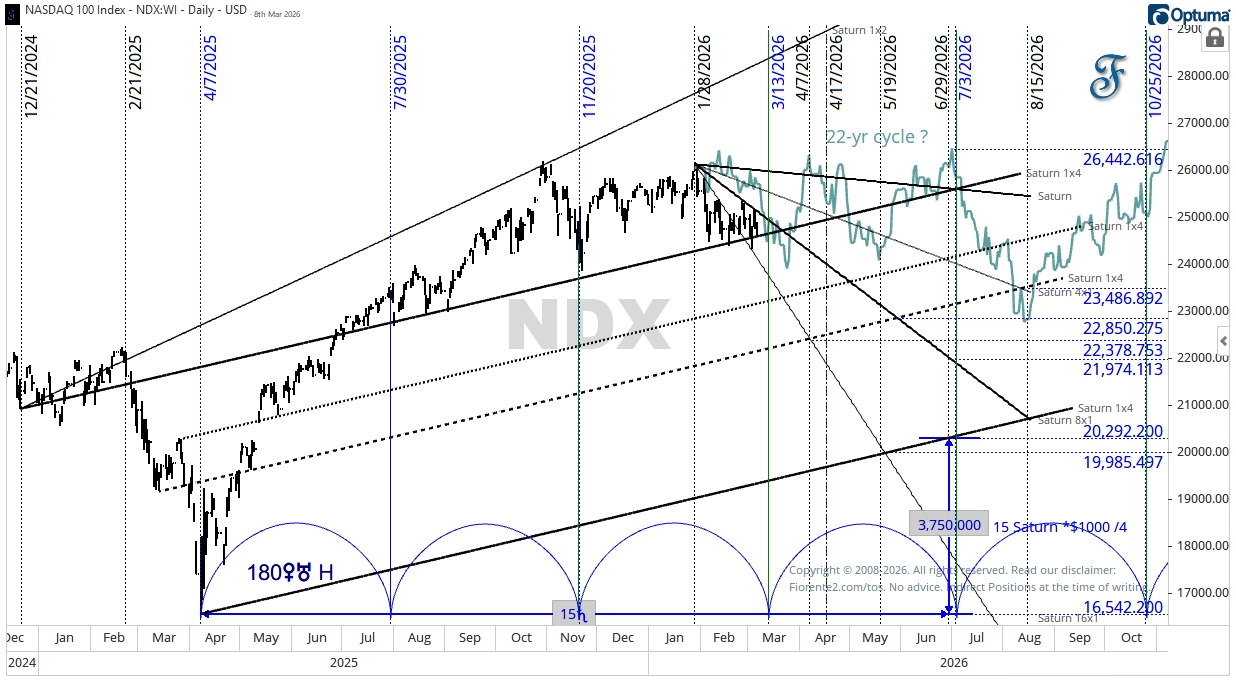
When panic takes hold of investors, I can imagine the Nasdaq declining to the mid-channel timing line (dashed), or even lower, with similar volatility as the other US indices, to the Saturn 1x4 timing line. Even if the index ends up as low as around 20k, the overall bullish long-term trend remains intact.
Multiple Cycles
When considering other cycles that may be at work, I posted the DJIA chart (updated) below in previous posts. Compared to previous posts, I have removed a few cycles that may have become less relevant.
Note: You can see that the forecast does not imply a price forecast, as it is indexed to past cycles, so Time is more important than Price on this chart.
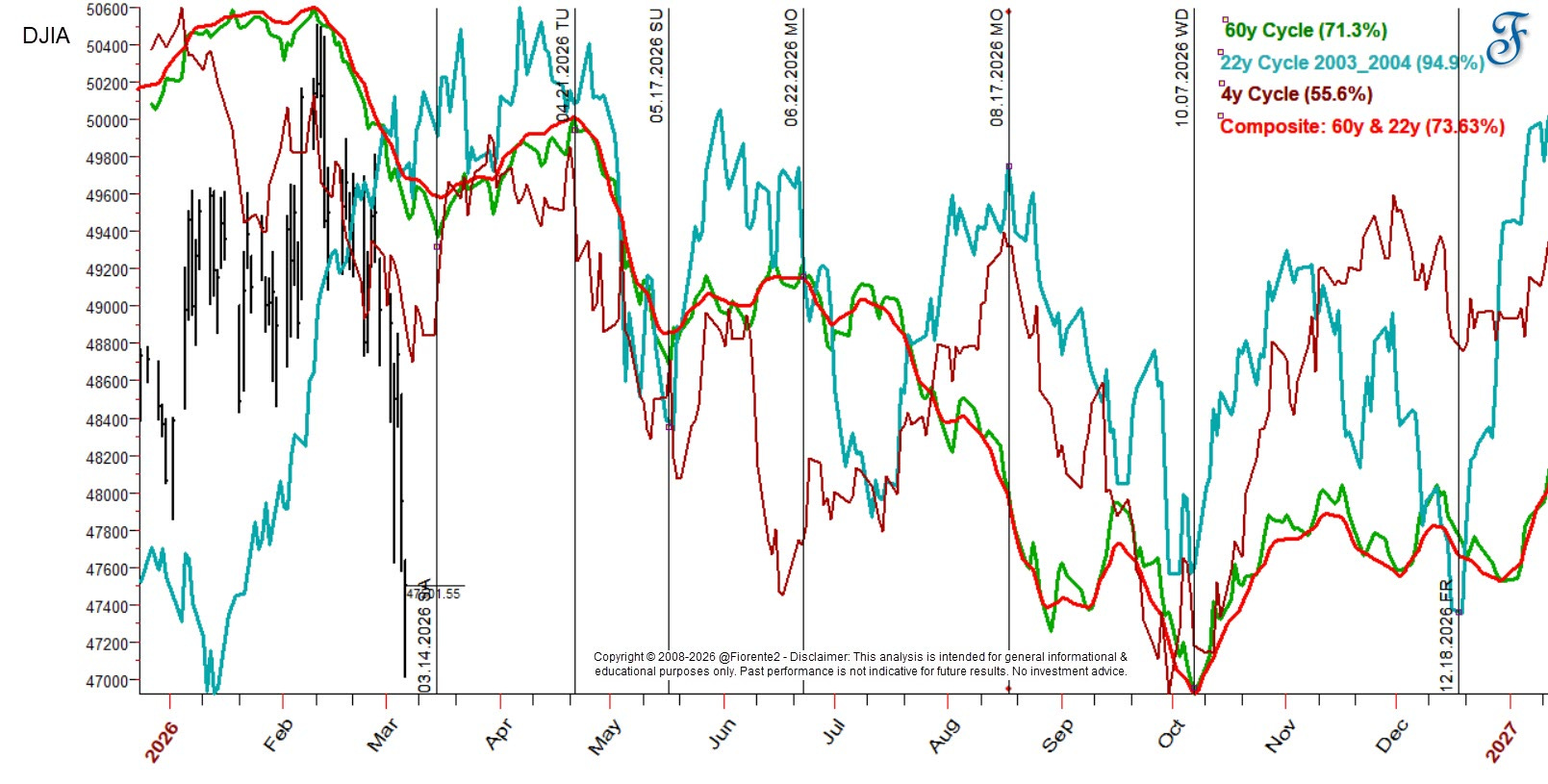
You can see on this chart that other cycles share one common factor: a low is expected in the third quarter of 2026, but their downward paths may begin earlier or later this year. So, be careful about concluding that a downward trend has already started based only on the 60- or 22-year cycle.
Top-20 US Stocks
From a Top-20 US Stock perspective, the majority of the stocks that drive the US Indices seem to be fundamentally or technically overbought, which adds to my hypothesis that there is enough reason to believe the US Indices could seek lower lows.
Some stocks, like MSFT and Oracle. show a Slow Stochastic (25,3,3) smaller than 20 on a weekly scale, which could signal they may have found an intermediate bottom for now. But such a signal should always be confirmed with other indicators.
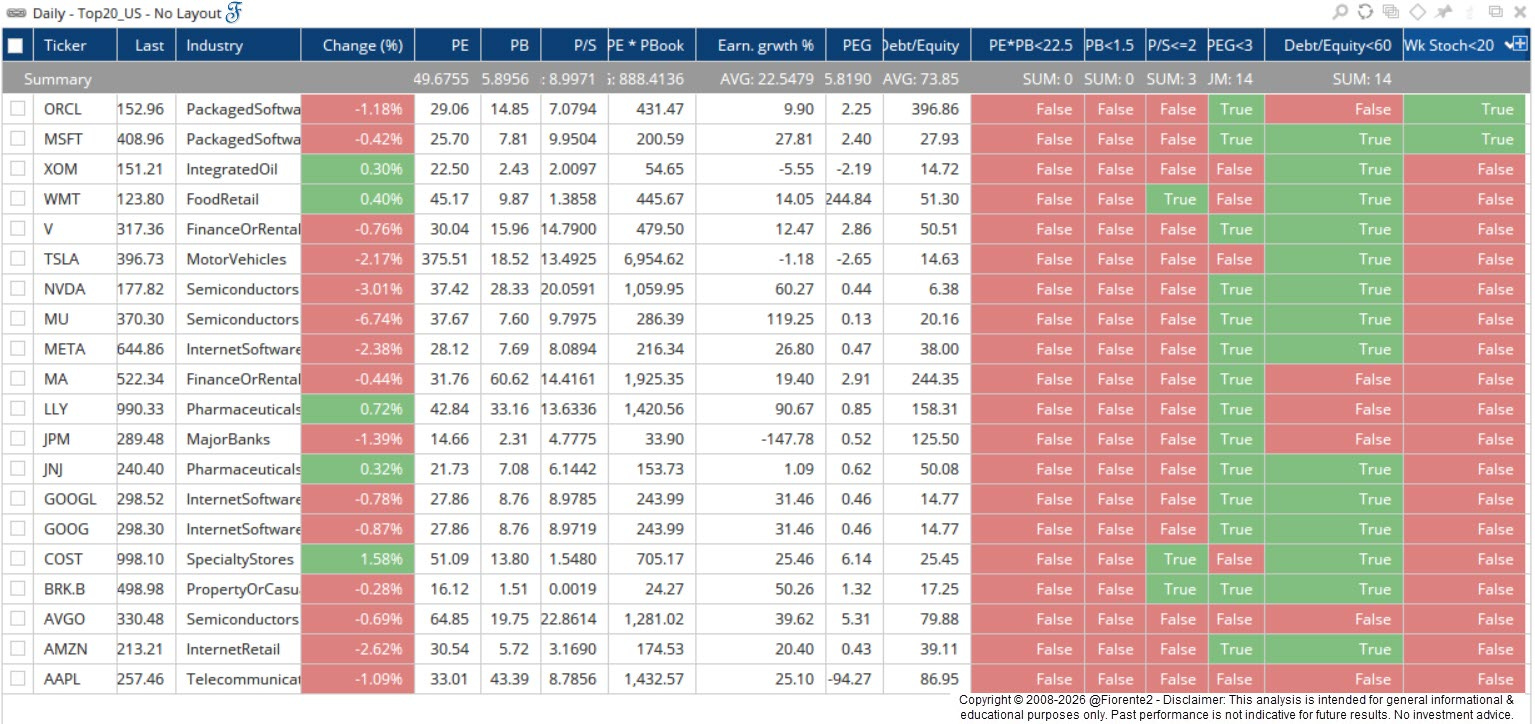
Based on sound fundamental or technical criteria, I would like to see lower Price-Earnings Ratios (PE), Price-Book (PB), or Price-Sales (P/S) ratios. For a rebound, I would prefer the weekly slow Stochastic indicator (last column) to be below 20 and preferably forming a higher low before considering taking any additional positions in these stocks.
Conclusion
The forecast on the US Indices and crude oil has recently followed the main cycles identified in the previous post.
On the US indices, a first leg of the 60-year cycle downwards may continue into mid-March, which might correlate with the Venus-Uranus Synodic cycle. As most Top-20 stocks on a weekly time frame are not yet in overbought territory from a technical analysis point of view, this might indicate we may not have found a low yet.
For Crude Oil, if the Strait of Hormuz remains blocked, Crude Oil may continue to rise to the resistance levels equivalent to the Saturn timing lines running from 2014.
At times like this, I stay out of the markets and will see what happens. When volatility subsides, we may see some good opportunities to take new positions.
This is my current bias on crude oil and across the US stocks and indices. Remember, cycles can contract, extend, and invert. I may be wrong, of course. Anomalies can occur, fundamentals can shift, so be cautious. I expect some significant volatility ahead.
In case you haven’t noticed, I post various charts in the Substack notes every week. You can find them all here. (click on the link)
P.S.: Occasionally, I share new analyses exclusively for free subscribers. Subscribing gives you email updates on these posts, plus extra insights and deeper research from the time you join onward; past analyses are not included.
If you liked this post from @Fiorente2’s Blog, why not restack and share it?
© 2008–2026 Fiorente2.com. All Rights Reserved.
Disclaimer: This analysis is for informational and educational purposes only and should not be considered investment advice. Read our full disclaimer.
Disclosure: From time to time, I may hold positions in the securities mentioned.
US Energy Information Administration